Around 90% of world trade travels by sea, and every vessel in that fleet depends on a crew that is certified, medically fit, and legally cleared to sail. Yet the people side of shipping remains one of the least digitised parts of the supply chain. The BIMCO/ICS Seafarer Workforce Report points to a widening gap between the number of certified officers the world fleet needs and the number actually available a shortfall that grows heavier as the fleet expands and older officers retire.
This case study looks at how one operator responded to that pressure by removing intermediaries from the hiring chain rather than adding more of them.
Background
Marine MAN Ltd was established in 2007 as an integrated maritime services company and holds an IMO Document of Compliance. Its offices span Ukraine, Estonia, Poland, Cyprus, Turkey, Georgia, India, and Indonesia, with a partner agency in the Philippines a footprint that deliberately follows the world’s main seafarer supply countries rather than its main shipowning centres.
The company’s core services combine crew management, technical ship management, ISM/ISPS/MLC compliance, and insurance administration under a single contract.
The Challenge
Traditional maritime hiring runs through a chain of local manning agents, each with its own database, fee structure, and paperwork standards. For a shipowner filling an urgent vacancy, that chain creates three recurring problems:
- Time. A single replacement can take weeks to source, vet, and mobilise, while the vessel waits or sails short-handed.
- Cost opacity. Agency margins are layered rather than disclosed, so the true cost per seafarer is difficult to benchmark.
- Data fragmentation. Certificates, sea service records, and medical documents live in unconnected files, and expiry dates are discovered late.
For seafarers, the same chain produced a mirror-image problem: no reliable way to see who was actually hiring, and a market where paying for a contract remained a real risk.
The Solution
The company’s answer was to build its own recruitment platform, jobmarineman.com, and open it directly to both sides of the market. The platform now supports 11 languages and holds a candidate database of roughly 190,000 CVs.
Three design decisions shaped it:
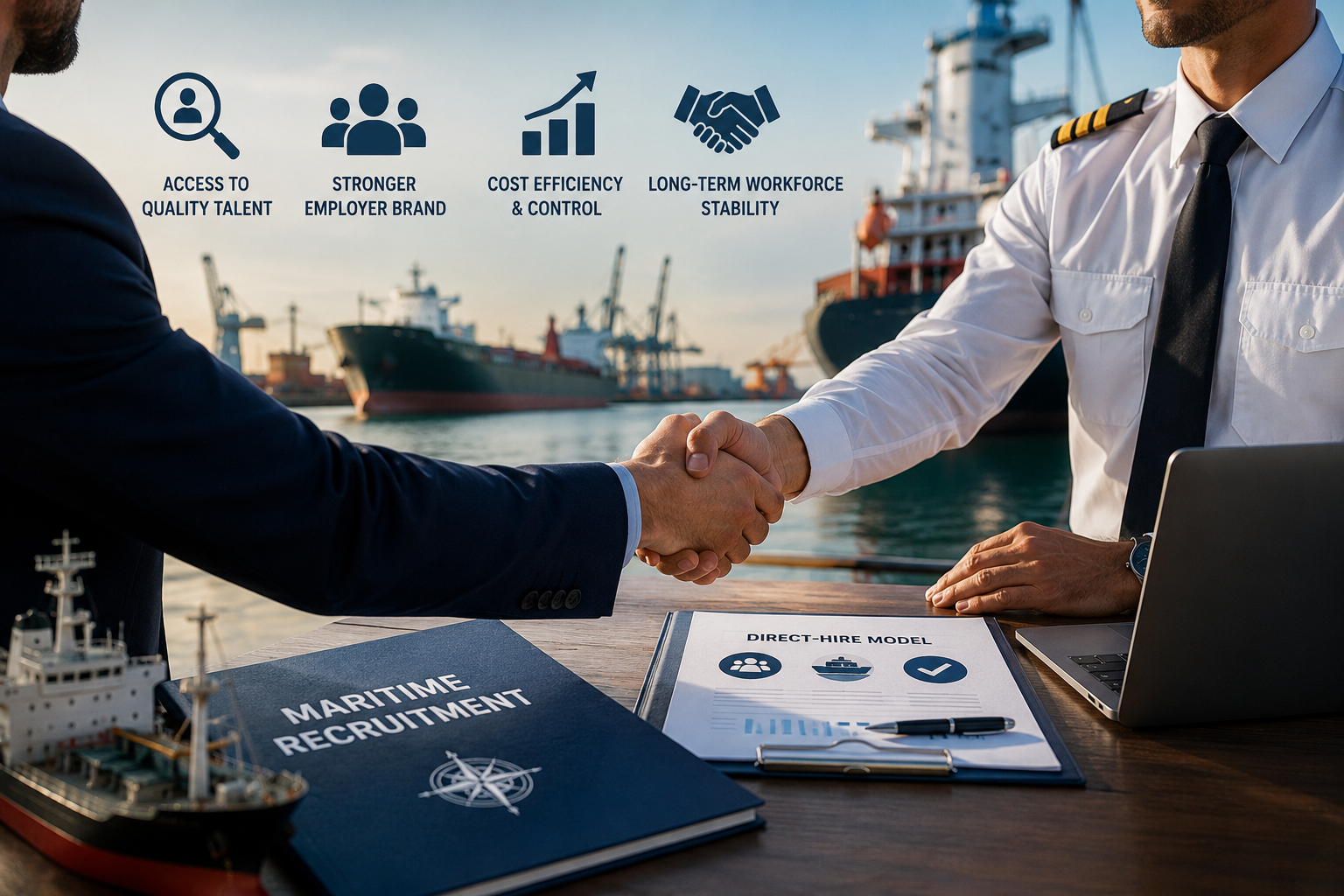
- Direct contact. Shipowners and crewing departments reach candidates without an intermediary layer, and seafarers apply without paying for placement.
- Job sea search built around real filters. Vacancies are structured by rank, vessel type, contract length, and required certificates, so the shortlist is relevant before a recruiter opens it.
- Document-first profiles. Certification and sea service data sit in the candidate record itself, which shortens the verification stage rather than pushing it to the end of the process.
Results
More than 350 seafarers have been placed through the platform, and the underlying database has become the company’s main operational asset the pool it draws on for both platform hiring and full crew management contracts. The clearest gain has been at the front of the process: shortlists that used to depend on which agent answered the phone are now produced from a searchable pool covering multiple supply countries at once.
Lessons for Other Businesses
Own the data layer. In a fragmented market, the durable competitive asset is rarely the service itself it is the verified database behind it, which competitors cannot replicate by lowering their price.
Disintermediation works where trust is scarce. Removing fees for one side of a marketplace looks like lost revenue until it becomes the reason that side shows up at all.
Localise before you scale. Operating in 11 languages and eight countries is expensive, but a labour marketplace only functions where the labour actually lives.
The broader point applies well beyond shipping: as skilled labour becomes the binding constraint in an industry, the companies that gain are those that treat recruitment as core infrastructure rather than an outsourced administrative task.
Let’s discuss cooperation
Want to know how our team can help your business? Contact us: b2b@marineman.eu