
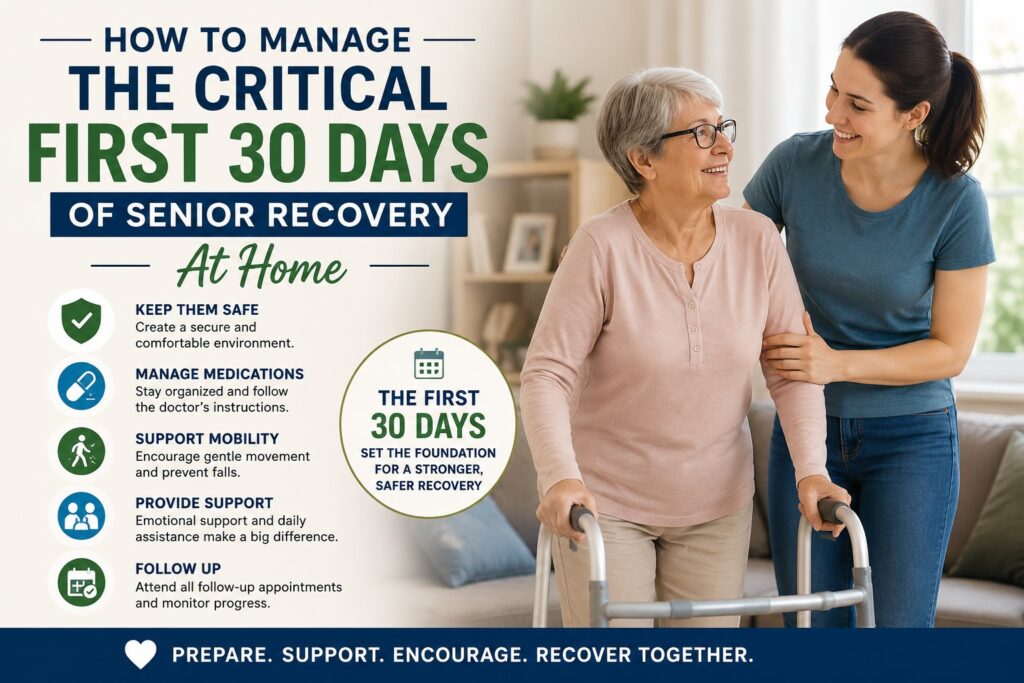
The month following a hospital discharge is the most treacherous time of a senior’s recovery. Almost 20% of Medicare beneficiaries will be readmitted within 30 days of discharge, and many of those readmissions could have been prevented (New England Journal of Medicine). If you’re the one overseeing a parent or spouse’s return home, the choices you make in the first 48 hours will influence the rest of their recovery.
Start Before They Leave the Hospital
Start a few days in advance. Two days before the estimated discharge date, ask the discharge planner for a copy of the complete transition plan. This should detail every new drug the person will be taking along with therapy and specialists’ appointments that will need to be scheduled in the first week to ten days post-discharge. Home health or outpatient prescriptions, equipment orders, and necessary new Medicaid waivers should be outlined as well. Also, ask to see the physical or occupational therapist’s recommendations and schedule if they aren’t included in the main transition plan.
Prepare the Home Before Arrival
Perform a quick safety appraisal before the senior even gets home. This isn’t a simple clean-up assignment, it’s a focused risk-reducing activity.
Toss out all loose throw rugs. Clear a direct route from the bed to the bathroom and to the kitchen. Add grab bars in the shower and by the commode if they’re not already there. Take a look at lighting in hallways and on stairs, especially if the senior will be disoriented if he wakes up during the night.
If the discharge planning team has ordered durable medical equipment, such as a walker, shower chair, or hospital bed, make sure that it is delivered before the patient arrives home, not the morning of.
Build a Structured Care Model For the First Two Weeks
The biggest error that families commit is believing that they can manage everything alone. Caregiver exhaustion is a reality, and it usually appears in the second week, once the excitement from the time of discharge vanishes and the daily schedule becomes exhausting. An elderly person recovering from surgery, a stroke, or a grave illness usually demands help with ADLs, bathing, dressing, transferring, several times each day.
Extreme 24/7 family care is overwhelming and isolating. Someone must go back to their job. Someone must sleep. Lives outside of caregiving must go on. The patient is left alone when everyone else’s day is busiest and most stressful.
A hybrid model works best. Family can do meals, companionship, and overnight stint, while professional home care services handle the most demanding hours. Working with an agency like All American Home Care gives families access to trained aides who can assist with the morning routine, possibly the riskiest and most demanding 2 hours of the day, and the rough equivalent, the late afternoon to early evening.
Medication and Nutrition Require Daily Attention
Create a physical medication management system from the get-go. At minimum, you want a weekly pill organizer that’s color-coded by time of day. A five-times-a-day post-hospital painkillers regimen is common. Seniors are easier to over sedate than to under-sedate. If your older adult is taking five or more medications, a digital dispenser that sorts pills and beeps when it’s time to take them is a justified expense.
Next, calories matter more than ever in the first couple of weeks after a hospitalization. You may be alarmed one day after the hospital at how weak the older adult is. But often the weakness is due more to two weeks of poor intakes while in the hospital, coupled with dehydration, than to the condition itself. Many people don’t come home from the hospital terribly hungry.
Experts advise preparing a few days’ worth of high-protein, high-calorie foods before the hospital even discharges them, and serving easily eaten calorie-dense foods, since many seniors are too weak to eat vast quantities. Don’t rely on the senior asking you for food or drink since this may not happen. Just leave a yummy soup, hot cereal with cream and brown sugar, shake, or supplement drink within reach and let them nibble all day if that seems appealing. The other best way to coax better eating is to eat with them. Leave a bowl of high water content fruit in the evening and another in the morning for breakfast.
Signs That Something is Wrong
Any family caregiver managing this transition should know the basic warning signs that warrant a same-day call to the doctor. If you are concerned that new symptoms have arisen, be vigilant and call the after-hours service, primary doctor or home health nurse. Sudden disorientation or confusion, new leg or foot swelling, shortness of breath, a sore that is hot, painful, swollen, or draining should all be reported the same day you first see them.
A fever above 38°C (100.4°F) also falls into this category, as does any sudden change in urine, dark colour, strong odour, or complaints of burning, which can signal a urinary tract infection. UTIs in older adults frequently present without the classic symptoms and instead cause rapid-onset confusion or a noticeable drop in energy, making them easy to miss if you are not watching for them.
Falls deserve particular attention during recovery. Even a minor stumble with no visible injury should prompt a call, because older adults can sustain fractures, particularly hip fractures, without obvious pain in the immediate aftermath. If your parent seems reluctant to bear weight, moves more stiffly than usual, or complains of groin or thigh discomfort following a fall, do not wait to see if it improves.
Changes in appetite or fluid intake that persist beyond a day or two are also worth flagging. Dehydration accelerates quickly in elderly patients and can spiral into serious complications before anyone realises how far it has gone. If meals are being refused consistently, if the person seems unusually drowsy or hard to rouse, or if they have not had much to drink despite prompting, contact the care team.
Trust your instincts as a caregiver. You are the person most familiar with your parent’s baseline, their usual mood, their typical energy level, the way they normally speak and move. When something feels off even if you cannot name exactly what, that sense is worth acting on. Doctors and nurses expect these calls and would always rather hear from you early than late.
The Follow-up Appointment is Non-Negotiable
During the 7-to-10-day follow-up, the primary care physician or specialist will review the transition plan and make any necessary adjustments. It may cover things like wound checks, staples removal, physical therapy, changing medications, or ordering blood tests. This is also a good time to address any specific challenges a senior is having.
To make the most of this appointment, be sure to bring the full medication list, a written log of any symptoms or questions from the first week, or any problems the caregiver is encountering with certain aspects of care (for instance, how to appropriately clean and redress a wound), and any questions about activity or recovering that need to be clarified.