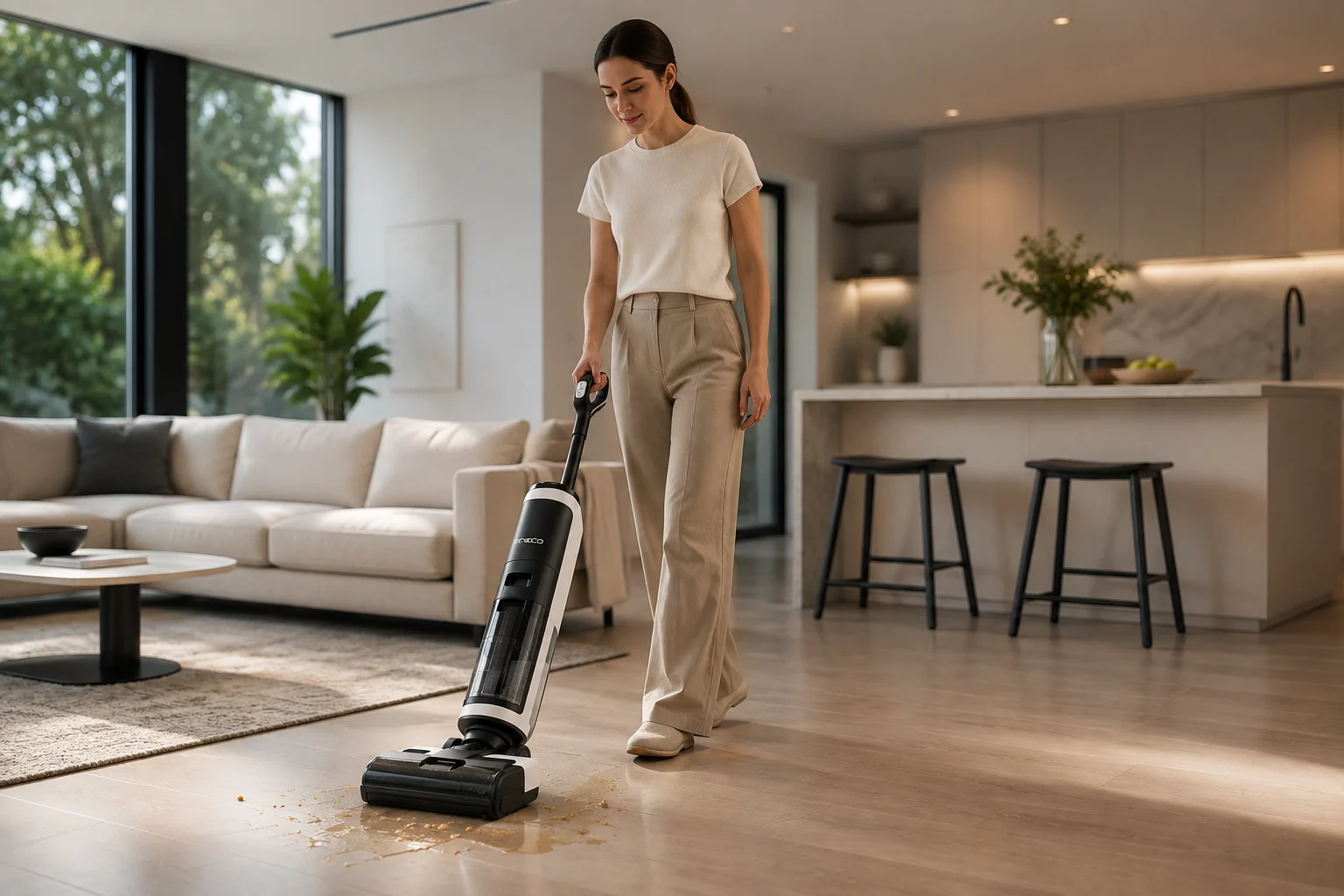

Marketing strategy is easiest to understand when it is applied to a real market.
The UK floor-care market provides a useful example.
Traditional vacuum cleaners are already a mature consumer category, but wet-dry floor cleaners have created a newer sub-category by combining two household tasks — collecting suitable dry debris and washing hard floors — into one appliance.
That has created a different marketing challenge.
Manufacturers are not only trying to persuade consumers that their product is better than a competitor’s.
They are also trying to explain:
- what the category does;
- why consumers might need it;
- which features matter;
- why one model costs more than another.
Tineco provides a useful case study because its UK FLOOR ONE range illustrates several important marketing concepts at the same time:
segmentation, targeting, positioning, product differentiation, the marketing mix, product portfolio strategy and product life-cycle thinking.
The case also shows why successful marketing depends on more than adding features.
The product, price, place and promotion decisions need to support the same target customer.
The market opportunity
Marketing starts with customer needs.
Business Case Studies describes marketing as involving the identification and satisfaction of customer requirements, with the marketing mix combining the right product, price, place and promotion.
For wet-dry floor cleaners, the underlying customer problem is straightforward.
A traditional hard-floor routine can involve:
- vacuuming loose debris;
- putting the vacuum away;
- preparing a mop;
- washing the floor;
- cleaning the mop afterwards.
Wet-dry floor cleaners attempt to reduce this into a more integrated process.
From a marketing perspective, that means companies are not simply selling another vacuum cleaner.
They are selling a different solution to an existing consumer problem.
That distinction is important.
A successful campaign must communicate the benefit:
fewer separate cleaning stages
rather than only describing the technology inside the machine.
Where is the market in the product life cycle?
The product life cycle is often divided into:
introduction → growth → maturity → decline.
Business Case Studies uses product life-cycle analysis to show how organisations adapt marketing decisions as customer demand and competition change over time.
The UK wet-dry floor-cleaning category shows several characteristics commonly associated with the growth stage:
- more brands entering or expanding in the category;
- broader product ranges;
- rapid feature development;
- continuing consumer education;
- competition based heavily on differentiation.
However, this should be treated as a reasoned interpretation rather than a proven market classification.
Without complete market-sales data over time, it would be too strong to state that the entire category is definitively in one life-cycle stage.
For students, this creates a useful question:
What evidence would a marketing manager need before formally classifying a market as being in the growth stage?
Possible evidence would include sales growth, household penetration, competitor entry, advertising expenditure and product-range expansion.
Marketing objective: make the category understandable
A younger product category creates a particular communications challenge.
If consumers already understand what a product does, promotion can focus heavily on:
- brand preference;
- price;
- emotional positioning.
But when a category is less familiar, companies often need to educate the market as well.
For a wet-dry cleaner, consumers may ask:
- Does it vacuum and mop at the same time?
- Do I need to vacuum first?
- Can I use it on laminate?
- Is it suitable for pet hair?
- How is it different from a steam mop?
- Do I still need a normal vacuum?
These questions are not just customer-service questions.
They are marketing questions.
If consumers do not understand the product, the business faces a barrier before brand preference even begins.
Segmentation, targeting and positioning
Business Case Studies explains segmentation as dividing a broad market into groups with different characteristics and needs, followed by targeting and positioning.
That framework is particularly useful here.
A wet-dry floor-cleaner market could be segmented by:
Household type
- single-person households;
- families;
- pet owners;
- larger households.
Property type
- compact flats;
- larger homes;
- furniture-heavy interiors.
Flooring
- tile;
- sealed wood;
- laminate;
- LVT;
- mixed flooring.
Cleaning behaviour
- frequent light cleaning;
- pet-related cleaning;
- sticky kitchen mess;
- deeper periodic cleaning.
Benefit sought
- convenience;
- low maintenance;
- under-furniture access;
- steam-assisted cleaning;
- automation.
These segments allow different products to be positioned around different benefits.
The S7 Stretch Ultra: benefit-led positioning
The Tineco FLOOR ONE S7 Stretch Ultra Cordless Wet Dry Vacuum Cleaner provides a useful example.Tineco FLOOR ONE S7 Stretch Ultra Cordless Wet Dry Vacuum Cleaner
Its current UK product proposition includes a 180-degree lay-flat design, DualBlock Anti-Tangle, FlashDry and up to 50 minutes of runtime.
The strongest marketing benefit is not simply:
“This model bends to 180 degrees.”
That is a product feature.
The customer benefit is:
It can reach beneath low furniture more easily.
This distinction between a feature and a benefit is central to good marketing.
Feature
180-degree lay-flat design.
Functional benefit
Reaches beneath beds, sofas and low furniture.
Customer value
Less furniture moving and easier cleaning of difficult areas.
That can appeal particularly strongly to consumers with:
- low sofas;
- beds with limited clearance;
- compact layouts;
- pets whose hair gathers underneath furniture.
It would be too strong to claim that Tineco officially designed the model only for “small homes”.
A better marketing interpretation is that its benefit naturally makes it relevant to consumers for whom under-furniture access is a significant problem.
The S9 Boost Steam: moving customers up the product range
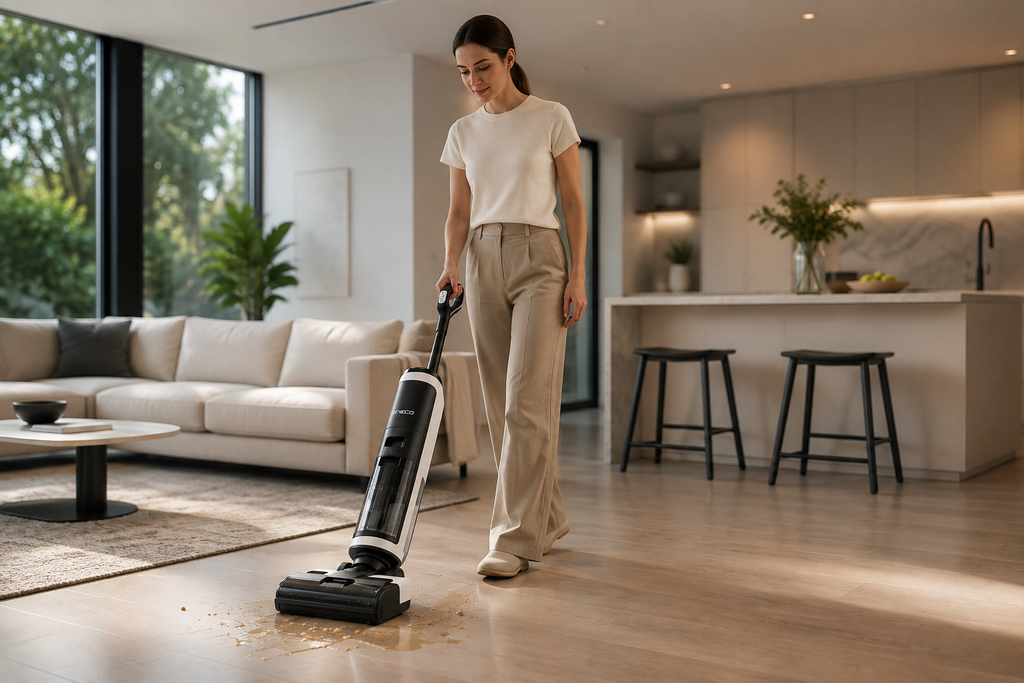
Tineco’s Tineco FLOOR ONE S9 Boost Steam Wet Dry Vacuum Cleaner provides a different proposition.
The current UK model combines features including 25kPa suction, HyperStretch, FlashDry/SilentDry and AI SmoothDrive, together with steam-assisted cleaning.
From a marketing perspective, this is useful because it illustrates premium product positioning.
The consumer is not simply being asked to buy:
“a more powerful floor cleaner.”
The premium proposition is built from a bundle of added benefits:
- steam-assisted cleaning for stubborn residue;
- more automation;
- self-maintenance;
- improved manoeuvrability;
- premium design.
The marketing challenge is to make consumers believe that those additional benefits justify the higher price.
That is where product and price decisions become closely connected.
The marketing mix: Product
Business Case Studies repeatedly emphasises that the 4Ps work together rather than independently.
For Tineco, Product is particularly important because differentiation is central to the category.
Product decisions include:
- wet-dry cleaning architecture;
- steam on selected models;
- anti-tangle systems;
- lay-flat design;
- self-cleaning;
- heated drying;
- sensors;
- battery life;
- tank capacity.
However, adding features is not automatically good marketing.
Every added feature also creates potential costs:
- higher manufacturing cost;
- higher selling price;
- more complex customer communication;
- potentially more maintenance;
- possible confusion between models.
Therefore a product manager must ask:
Does this feature create enough perceived customer value to justify its cost?
Price: creating a product ladder
Price is not simply a financial decision.
It communicates positioning.
A range containing several models allows a company to create a product ladder.
Consumers can self-select depending on:
- budget;
- desired features;
- perceived value.
One buyer may choose a simpler model because simultaneous wet-dry cleaning is enough.
Another may pay more for lay-flat access.
A third may move into the premium tier for steam-assisted cleaning and greater automation.
This strategy can increase the number of market segments the brand can serve without relying on one single product.
It also helps explain why product portfolio management matters.
A range must contain enough differentiation to justify the price gaps between models.
If two models appear too similar, consumers may simply choose the cheaper one.
Place: where the customer encounters the product
“Place” refers to how products reach customers.
For a consumer appliance brand, this can include:
- the brand’s direct-to-consumer website;
- online marketplaces;
- electrical retailers;
- physical retail;
- comparison and review sites.
The channel matters because wet-dry cleaners can require explanation.
On a direct website, the manufacturer can control:
- demonstrations;
- comparison tables;
- FAQs;
- videos;
- technical explanations.
A physical retailer may provide another advantage:
customers can see the size, weight and design in person.
This creates a useful business-studies question:
Which distribution channel is most effective for a relatively unfamiliar product that consumers may want demonstrated before purchase?
The answer may involve a multi-channel strategy rather than one channel.
Promotion: education before persuasion
Promotion in this category has to do two things.
First:
explain the category.
Second:
differentiate the brand.
That means effective promotional content may combine broad educational queries such as:
- What is a cordless wet and dry vacuum cleaner cleaner?
- Can it vacuum and mop at the same time?
- Do you need to vacuum first?
with more brand-specific messages such as:
- lay-flat cleaning;
- anti-tangle;
- steam-assisted cleaning;
- self-cleaning;
- heated drying.
This creates a classic marketing funnel.
Awareness
“What is a wet-dry floor cleaner?”
Consideration
“Wet-dry cleaner vs vacuum and mop.”
Comparison
“Tineco vs Dreame.”
Product evaluation
“S7 Stretch Ultra vs S9 Boost Steam.”
Purchase
Price, availability, warranty and offers.
For SEO and AI-search visibility, this structure is particularly important because consumers increasingly begin their buying journey with questions rather than brand names.
Product portfolio strategy
A company rarely wants every model in its range to compete for exactly the same buyer.
That creates cannibalisation.
Instead, a strong product portfolio gives each model a clearer role.
A simplified interpretation could look like this:
| Consumer need | Possible positioning |
| Everyday wet-dry cleaning | Core category proposition |
| Pet hair and tangling | Anti-tangle benefit |
| Low furniture | Lay-flat benefit |
| Stubborn dried residue | Steam-assisted benefit |
| Less post-clean work | Automated cleaning/drying |
| Premium convenience | Combination of several advanced benefits |
This is not an official Tineco segmentation map.
It is a marketing-analysis framework showing how a firm might differentiate products across a portfolio.
That distinction is important for a case study.
Competitive positioning
The wet-dry market also provides useful examples of different positioning strategies.
Tineco
Strong emphasis on:
- integrated wet-dry cleaning;
- sensors;
- self-maintenance;
- anti-tangle systems;
- lay-flat designs;
- steam on selected models.
Dreame
Recent premium models place strong emphasis on:
- heated cleaning;
- automated washing and drying;
- lay-flat capability.
Shark
HydroVac uses a relatively straightforward combined vacuum-and-wash proposition.
Bissell
CrossWave benefits from a long-established association with multi-surface wet-dry cleaning.
Dyson
Dyson is particularly interesting from a marketing perspective because it entered dedicated wet-floor cleaning with substantial existing brand equity.
However, its WashG1 does not simply extend its conventional suction architecture.
It uses two counter-rotating rollers, controlled hydration and mechanical extraction.
This makes Dyson a useful example of brand extension combined with product innovation.
The company can transfer:
- awareness;
- design reputation;
- customer familiarity;
into a neighbouring market.
But it still needs to explain why its new product architecture is valuable.
Brand extension: opportunity and risk
Brand extension can reduce the cost of building awareness.
Consumers already recognise the name.
However, it creates risks.
If consumers strongly associate a brand with one category, they may not automatically understand its relevance to another.
For Dyson, consumers may associate the name with:
- cordless vacuum cleaners;
- airflow;
- premium engineering.
Wet-floor cleaning requires a different product story.
For specialist brands such as Tineco, the challenge is different.
They may have stronger category-specific associations among wet-dry cleaner shoppers but lower general brand awareness among the wider population.
This creates two contrasting marketing problems:
established brand entering a newer category
versus
category specialist building broader brand awareness.
That is a much stronger class discussion than simply asking which product is “best”.
USP or point of difference?
The original draft described steam as a USP.
That needs more precision.
A unique selling proposition should be something that meaningfully distinguishes the brand or product in the customer’s mind.
But a feature is not automatically a sustainable USP simply because competitors do not all offer it.
Steam-assisted cleaning can be a point of differentiation, but competitors may imitate similar functionality.
Therefore the longer-term competitive advantage may come from a combination of:
- product engineering;
- brand;
- user experience;
- service;
- range architecture;
- customer reviews;
- innovation speed.
This demonstrates an important marketing lesson:
A feature can create short-term differentiation without necessarily creating long-term competitive advantage.
What role do reviews play?
Consumer technology also involves perceived risk.
A buyer can read specifications before purchase.
But they cannot fully know:
- long-term reliability;
- maintenance burden;
- noise;
- manoeuvrability;
- real-world cleaning convenience.
Reviews therefore become part of the information environment surrounding the product.
From a marketing perspective they can provide:
Social proof
Evidence that other consumers have purchased and used the product.
Risk reduction
Real-world comments may reduce uncertainty.
Product-development feedback
Recurring complaints can reveal weaknesses.
Messaging insight
Repeated praise can reveal which benefits consumers actually value.
This means reviews are not only a sales tool.
They can feed back into the marketing strategy.
SEO and GEO: why customer questions matter
Modern marketing increasingly includes search behaviour.
Consumers do not always search directly for:
“Tineco S7 Stretch Ultra”.
They may ask:
- What is the best wet and dry vacuum cleaner in the UK?
- Is Tineco worth it?
- Can Tineco vacuum and mop at the same time?
- Which Tineco is best for pet hair?
- Is Tineco safe for laminate?
- Tineco vs Dreame: which is better?
- Do wet-dry vacuums replace a normal vacuum?
- Is steam worth paying more for?
These queries reveal consumer intent.
That makes them useful beyond SEO.
They can inform:
- segmentation;
- product pages;
- FAQs;
- comparison content;
- advertising;
- product positioning.
In other words:
search behaviour can function as market research.
That is a particularly useful modern extension to the traditional business-studies framework.
Key marketing challenges
The case reveals several challenges Tineco and competing brands need to manage.
Challenge 1: category education
Consumers need to understand what wet-dry cleaning does.
Challenge 2: differentiation
Brands need distinctive propositions without overwhelming consumers with features.
Challenge 3: price justification
Premium models need benefits that consumers believe justify higher prices.
Challenge 4: portfolio clarity
Too many similar models can create consumer confusion.
Challenge 5: brand positioning
Specialist brands need to build awareness, while established brands need to establish credibility in a new category.
Challenge 6: maintaining differentiation
Competitor imitation can quickly turn a USP into a standard category feature.
Student Discussion and Application Questions
It shows characteristics consistent with the growth stage, including widening product ranges, continuing innovation and consumer education. Students should also identify what market data would be required to confirm this conclusion.
The 180-degree lay-flat design is the feature.
Easier access beneath low furniture is the functional benefit.
Reduced furniture movement is the customer value.
Different product benefits can appeal to different needs, such as pet hair management, under-furniture reach, stubborn residue and reduced maintenance.
Not necessarily. It can create differentiation, but competitors may develop similar features. Sustainable competitive advantage may require a wider combination of product, brand, service and innovation.
Different product tiers allow consumers with different budgets and desired benefits to choose different models
Dyson has entered dedicated wet-floor cleaning from a strong existing position in adjacent floor-care categories, using existing brand awareness while introducing a different product architecture.
Consumers may struggle to understand the difference between models, increasing choice complexity and potentially causing cannibalisation.
Frequently searched questions can reveal concerns about floor compatibility, pets, maintenance, pricing and competitor comparison.
Product is highly visible because innovation is rapid, but students could argue that promotion is equally important because the category still requires consumer education.
Likely changes could include:
stronger price competition;
fewer meaningful feature differences;
increased emphasis on brand loyalty;
replacement purchasing;
promotions;
portfolio rationalisation.
Case Study Summary
The UK wet-dry floor-cleaner market is useful for studying modern marketing because it shows several concepts interacting rather than operating separately.
Tineco’s current FLOOR ONE range illustrates how a company can use:
product differentiation
to create specific consumer benefits;
segmentation and targeting
to appeal to households with different cleaning needs;
product portfolio strategy
to serve different willingness-to-pay levels;
and the marketing mix
to connect product features with price, distribution and promotion.
Competitors add further strategic contrast.
Dyson demonstrates brand extension.
Dreame shows feature-led competitive positioning.
Shark and Bissell provide alternative propositions within the same broad category.
The most important lesson is that marketing strategy is not simply about having more features than competitors.
A successful strategy connects:
customer need → target segment → product benefit → positioning → price → channel → communication.
That is also why the wet-dry floor-cleaner category makes a useful contemporary case study.
The technology may be relatively mundane.
The marketing decisions are not.
Glossary
Marketing mix — The combination of product, price, place and promotion used to meet customer needs.
Segmentation — Dividing a broad market into groups with similar characteristics or needs.
Targeting — Selecting the segment or segments the business wants to serve.
Positioning — Creating a particular perception of the product in the customer’s mind.
Product life cycle — A model describing introduction, growth, maturity and decline.
Product portfolio — The collection of products or brands managed by a company.
USP — A distinctive proposition intended to give consumers a reason to choose one product over alternatives.
Brand extension — Using an established brand name to enter a new product category.
Cannibalisation — When sales of one company product reduce sales of another product from the same company.
SEO — Optimising content to improve visibility in search engines.
GEO — Optimising content and information structure so generative AI systems can understand, retrieve and reference it effectively.
References
- Business Case Studies — Marketing Case Studies. The site currently organises real-company examples across marketing topics including Product Life Cycle, Segmentation, Marketing Strategies and the Marketing Mix.
- Business Case Studies — The Marketing Mix Case Studies. Product, price, place and promotion applied to real organisations and practical decisions.
- Business Case Studies — Creating the Right Marketing Mix. Explains the role of the 4Ps in matching products to customer requirements.
- Business Case Studies — Targeting a Market Segment. Segmentation, targeting and positioning framework.
- Business Case Studies — Product Life Cycle Case Studies. Examples of how companies manage products across different life-cycle stages.
- Tineco UK — FLOOR ONE S9 Boost Steam. Current product positioning and specifications used as a marketing differentiation example.
- Dyson UK — WashG1 Wet Floor Cleaner. Current wet-floor architecture using two counter-rotating rollers, controlled hydration and extraction.