
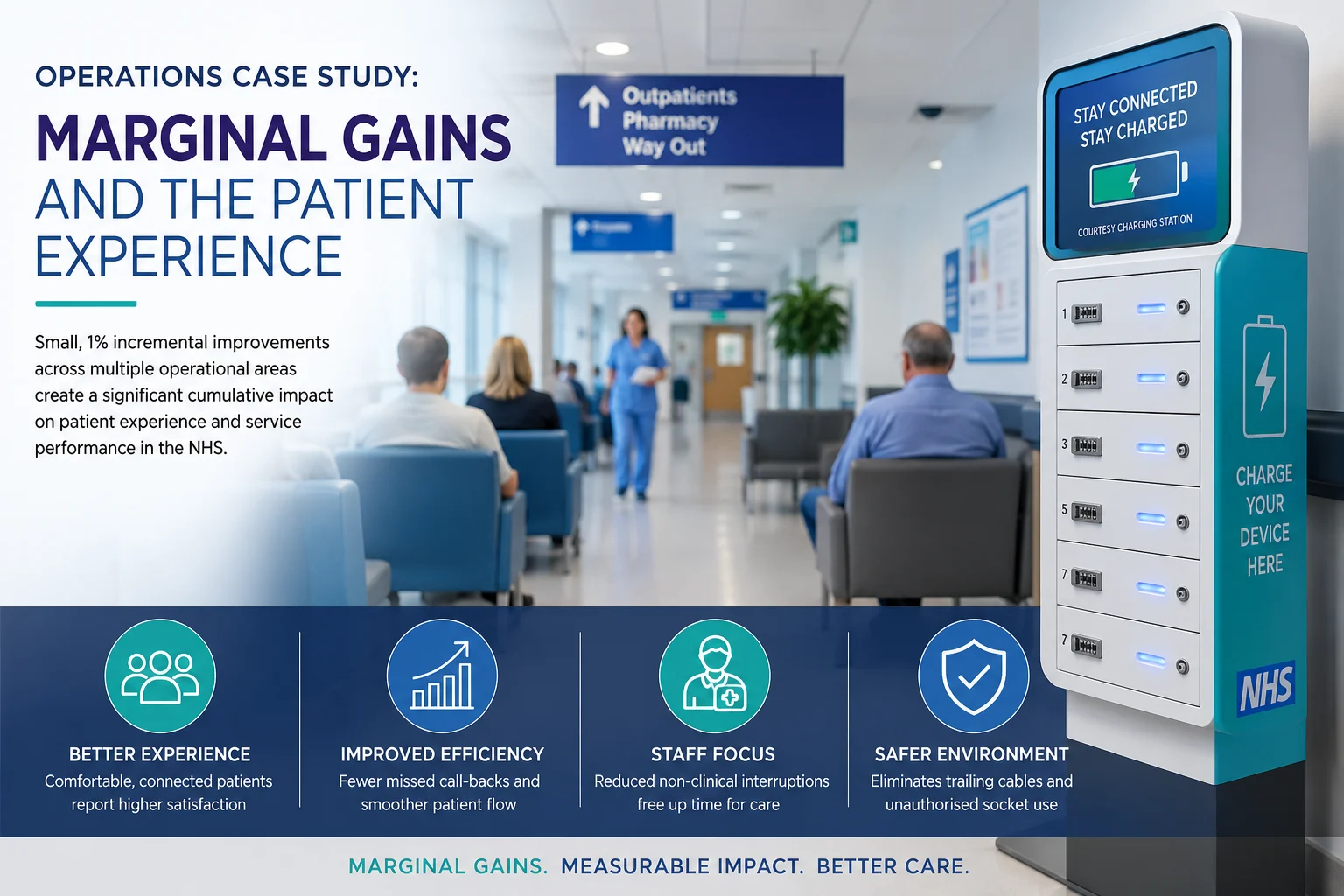
In classical operational management, Sir Dave Brailsford’s principle of “marginal gains”- the idea that small, 1% incremental improvements across multiple areas produce a significant cumulative performance advantage- is most often associated with high-performance sports, lean manufacturing, or supply chain logistics.
However, operational managers within the UK’s National Health Service (NHS) are increasingly applying this framework to non-clinical environment design to solve complex service delivery challenges and lift official patient experience metrics.
Under current NHS governance frameworks, patient and visitor satisfaction is no longer viewed as a superficial “nice-to-have.” It’s directly measured through the compulsory Friends and Family Test (FFT) and formally evaluated by the Care Quality Commission (CQC) under its key inspection domains, specifically whether services are “caring” and “responsive.”
While clinical outcomes, diagnostic accuracy, and triage speeds remain the core performance indicators, secondary environmental factors during wait times heavily dictate overall satisfaction scores and public trust.
The Stakeholder Landscape and Operational Bottlenecks
Emergency Departments (A&E) and busy outpatient clinics operate under chronic capacity constraints. Long waiting times create severe operational friction across a multi-layered stakeholder ecosystem:
- Patients: Experiencing acute physical pain, distress, or anxiety, patients find their psychological discomfort amplified by poor ambient conditions. When basic needs, such as seating, clear wayfinding, reliable Wi-Fi, and access to mobile device power, are unmet, perceived wait times feel exponentially longer than actual wait times. A dead mobile phone battery strips away distraction and prevents patients from updating employer or family support networks, escalating frustration.
- Visitors & Relatives: Accompanying visitors share the same stress environment. When they leave waiting halls to locate food, amenities, or power outlets, communication loops break down between families and care teams.
- Clinical & Reception Staff: Frontline administrative and nursing personnel frequently face non-clinical interruptions. Staff spend valuable time answering repetitive requests, such as providing directions, searching for spare charging cables, or managing inquiries about wall sockets, drawing attention away from patient intake and care coordination.
- Estates & Facilities Teams: Tasked with maintaining health, safety, and fire compliance, facility managers face risks when visitors use unauthorised wall outlets or run trailing charging cables across public waiting rooms, creating trip and electrical hazards.
From a pure workflow perspective, a critical operational failure occurs when patients wander away from immediate waiting zones to search for power or make phone calls. Missing a call-back creates a domino effect: clinicians waste time searching for missing patients, appointment slots slip, and overall department throughput slows down.
Evaluating Solutions: CapEx vs. OpEx Procurement Criteria
To mitigate these micro-frictions without diverting funds from clinical budgets, facilities managers must apply rigorous decision criteria to potential non-clinical amenities. Key evaluation factors include capital expenditure (CapEx) impact, operational expenditure (OpEx) feasibility, ongoing maintenance burdens, spatial footprint, and strict safety compliance.
Infrastructure overhauls, such as rewiring waiting rooms to add high-density wall sockets, require high initial CapEx approval, lengthy procurement cycles, and disruptive physical works. Instead, modern estate management favours flexible service-led solutions.
As part of these targeted micro-interventions, several trusts now install a hospital phone charging station in A&E and outpatient waiting areas, typically on a rental contract so it counts as revenue rather than capital spend.
By shifting from a capital purchase model to an operational rental contract, NHS facilities teams achieve several strategic objectives simultaneously:
- Financial Agility: Avoids capital sign-offs by utilising existing operational facilities budgets.
- Risk Transfer: The equipment remains fully maintained, updated, and electrically tested by the third-party supplier, eliminating maintenance overhead for internal engineering teams.
- Safety & Order: Free-standing, secure charging lockers or kiosks eliminate unauthorised socket use and dangerous trailing wires in high-traffic corridors.
Measuring Operational Outcomes and Key KPIs
The operational efficacy of marginal gains interventions relies on measurable output data. By addressing the root causes of secondary environment anxiety, NHS trusts report tangible improvements across key operational metrics:
- FFT and CQC Domain Improvement: Reductions in negative survey comments relating to waiting room facilities directly boost CQC rating indicators for “responsive” care.
- Patient Flow Efficiency: Keeping patients comfortably seated and reachable within designated waiting zones reduces missed call-backs, maintaining planned clinical throughput speeds.
- Resource Optimisation: Reception and nursing staff reclaim lost administrative minutes previously spent dealing with non-medical amenity requests, redirecting effort toward core operational tasks.
For business and operations students, this NHS case study illustrates a fundamental strategic truth: resolving minor, non-clinical friction points through smart procurement can deliver outsized gains in system efficiency, stakeholder satisfaction, and regulatory performance.


