
People have ideas all the time. In business, new ideas can lead to new products and services. They can lead to a better way of doing something. Ideas can come from existing businesses through research and development. For example, Apple, an established technology company, developed the iPod.
Ideas generate value to the economy by encouraging people to buy or invest in new developments. Many ideas come from entrepreneurs who go on to start up new businesses. They also inspire competitors to invent new products in order to regain market share.

Intellectual property rights (IPR) can be used to protect the technology, brand name, design and creativity behind the concept. It gives the creator sole ownership of the concept, in a similar way to owning physical property like a house or car. Owners can control the use of their intellectual property to gain financial reward.
The UK Intellectual Property Office (UK IPO) helps owners and entrepreneurs to protect their concepts or creativity by registering their intellectual property rights.
What is an entrepreneur?
An entrepreneur is someone that creates a new business. This can carry a high risk because it requires money to set up a new business without knowing if it will give a return on investment.
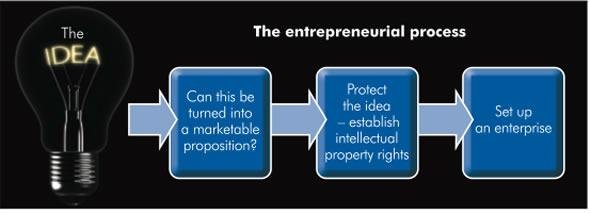
Entrepreneurs need to have a good understanding of their markets. They find out what customers want and modify their products in line with market requirements. They also need to have good ideas.
Matt Stevenson is a good example of an entrepreneur. Matt started keeping fish when he was nine. One day Matt’s sister decided to do him a good turn by soaking his fish tank gravel in bleach and of course all the poor fish died. From this, he realised the importance of creating an environment in which fish could flourish.
At university, Matt studied for a degree in marketing and product design. On completing his degree, he began research on adapting the traditional goldfish bowl. Goldfish bowls are quite small and do not filter the water. Matt designed a new environment to give fish more access to clean water. He registered his invention, was granted a patent and marketed his fish tanks under the biOrb name. Today biOrb is one of the biggest brands in the aquatic industry. In the first five years, turnover increased from £100,000 to about £4 million.
Setting up a business
To set up a new business, an entrepreneur needs to follow several steps:
- Develop new products and services. For example, the Innocent® brand of smoothies was created by three university students. They realised there was a market for fruit drinks made from completely natural ingredients. This new idea enabled Innocent to break into a market that was dominated by existing producers.
- Check that ideas are new. Entrepreneurs need to carry out a search of registered intellectual property to check that their idea does not already exist. Further information on searching intellectual property rights can be found at www.ipo.gov.uk
- Investigate if there are any barriers to setting up the business. Will the business need to comply with any legal requirements?
- Raise finance for the business.
Raising finance
All businesses need capital to operate. Long-term capital can be obtained from:
- the owners’ own money and savings
- other investors, by offering shares in the new enterprise
- banks other institutions, in the form of loans and grants
Businesses can raise substantial sums in this way. However, investors will want a share of profits and, possibly some voice in the running of the business. Banks will expect a business to pay interest on any loan. The entrepreneur may also have to offer some asset, such as their own home, as security against the loan.
The business will also need short-term capital. For example, Matt Stevenson needed cash to buy parts for his products. Ideally, some money can be generated from sales revenue. But entrepreneurs may raise some short-term finance by taking out a bank overdraft or by using credit cards. This is usually easy to arrange, but banks charge high rates of interest on overdrafts.
Types of business

An entrepreneur must also decide what type of business to establish. There are three main types of small businesses. Each has a distinct form and structure.
Sole trader
A sole trader is a business owned by one person. Many plumbers, electricians, window cleaners and other tradespeople work in this way. A sole trader may employ other people to assist with jobs, take phone calls or do the bookkeeping. It is simple to set up a sole trader business. There are few legal formalities.
Sole traders have complete control of their business they make their own decisions and take all the profits for themselves. However, sole traders can find it difficult to raise capital and they have liability for any debts incurred by the business. This means that sole traders potentially risk everything their savings, their homes and other assets if their business runs into trouble.
A partnership
This involves two or more people working together. The partners share the workload and the profits of the business. Partners will often have skills that complement each other and they can benefit from each other’s ideas.

However, partnerships do not always run smoothly. There can be disputes between partners. Like sole traders, partnerships often find it difficult to obtain capital. Most partnerships do not have limited liability. This means that each partner can be held responsible for all debts incurred by the partnership.
A company
This is a legal entity. It is owned by shareholders. The shareholders bring capital into the business. Shareholders take less risk than sole traders or partnerships because they have legal protection called limited liability. This means that if the business cannot meet its debts, then the maximum sum that shareholders can lose is limited to their investment in the company. Company decision-making is steered by a board of directors.
Why do entrepreneurs protect their ideas?
It is important for anyone to protect his or her ideas. This allows them to benefit from their creativity without their ideas being directly copied and exploited by others.

For entrepreneurs, the idea is often the entire basis for the new business. Without the idea, the business would not exist. Entrepreneurs invest money to develop business ideas. It is therefore essential that entrepreneurs safeguard this investment.
Benefits
Intellectual property (IP) rights provide entrepreneurs with many benefits:
- IP rights provide protection against a competitor directly copying the idea. This helps the entrepreneur to recover their costs in developing the idea.
- IP rights help businesses maintain their long-term competitive edge. Registered IP ensures that entrepreneurs get all the financial benefits from their ideas. Continued revenue will keep the business afloat.
- Registered IP is an asset. It helps convince financial institutions to invest in a business, enabling more money to be raised for development.
- Registered IP gives consumers confidence that products meet appropriate standards and quality.
- By being able to profit from their IP, entrepreneurs are rewarded for taking risks and developing new innovations. They can invest profits in working on new ideas.
- Ownership of the IP enables entrepreneurs to license or franchise ideas to others without risk. This means entrepreneurs are able to expand the market for their products and services more easily and can increase revenue for the business.
How do entrepreneurs protect their ideas?

There are four main categories of intellectual property rights (IPR). Each gives different protection and is used for different purposes.
Patents
Patents are for inventions. Entrepreneurs can seek patents for a new product or a new process that can be used in the industry. For example, James Dyson obtained a patent for his bagless vacuum cleaner. A patent can protect the invention, preventing other businesses from making, using, importing or selling similar products.
To apply for a patent, a business must submit a patent specification. This is a written description, often with drawings of the invention. This sets out what the invention does and provides important technical details. A patent can last up to 20 years; if it is renewed every year.
Designs
Registering a design prevents a competitor copying the physical appearance of a product or component. The appearance of a product includes lines, shape, contours, texture, colours and materials.
A registered design lasts initially for five years, although it can be renewed for up to 25 years. For example, registering designer fashions will stop others from using those designs. This helps to protect designs from being copied and appearing as cheap fakes on the high street.
Trademarks
A trade mark is a sign that can distinguish goods and services from those of other traders. A sign can include a combination of words, logos and pictures. To register a trade mark, it must be:
- distinctive for a group of goods and services
- not the same as (or similar to) any earlier marks on the register for the same or similar goods and services
A trade mark is a marketing tool which helps to develop and distinguish the brand. The trade mark also provides reassurance for consumers. People will recognise products more easily when they see them advertised. For example, goods bearing the Nike ‘tick’ logo demonstrate they are Nike products and meet Nike quality standards. Trade Marks can last indefinitely provided that they are renewed every 10 years.
Entrepreneurs register trademarks, designs and logos to protect and represent their brands. Branding delivers huge commercial value to a company. Many people recognise brands rather than individual products or services. Stelios Haji-Ioannou, the founder of easyJet®, uses trademarks to protect the ‘easy’ brand. The entrepreneurs behind Innocent smoothies use distinctive logos and trademarks to create a recognisable brand.
Copyright
Copyright is an IP right that relates to the expression of an idea, not the idea itself. For example, anyone can write a story based on the idea of a superhero, but they cannot copy the name, the text or illustrations from other books about the same subject.
Copyright protects sound recordings, films, broadcasts, photographs and original artistic, musical, dramatic and literary works. Unlike patents, designs and trademarks, copyright is an unregistered right. It applies as soon as something is created. There is no registration process or fee. It covers both printed and web-based materials.

Intellectual property also covers concepts as diverse as trade secrets, plant varieties and performers’ rights. Often, more than one type of IP may apply to the same creation. For example, the Harry Potter books, films and merchandise are covered by:
- copyright for the books and films
- design for some of the Harry Potter scarves and clothes
- trademarks for the Harry Potter range of toys, games, etc
An inventor who has a new idea should keep it secret until the idea is registered. If an idea is discussed in public, then it cannot be protected.
There is no worldwide legal protection. IP has to be applied for in each country. In Britain, the UK Intellectual Property Office is responsible for registering intellectual property rights.
Conclusion
Entrepreneurs take great ideas like Innocent smoothies, the biOrb fish tank and the easyJet budget airline and bring them to market by setting up new businesses. They invest energy, time and money in developing new ideas.
Starting up a new business is a high-risk activity there is no guarantee of return on investment. Registering patents, trademarks and designs protect them from being copied and gives the owner”s business a competitive advantage. This helps to take some of the risks out of the enterprise.