
Most inventory variances show up eventually. The unusual part of the Nature’s Touch story is where this one hid: inside a spreadsheet that fed both the company’s ERP and MRP systems every day for years without either platform flagging a problem. The case is worth examining because it answers a question many organizations are now confronting as they pursue AI initiatives: what happens when the data foundation itself can’t be trusted?
Nature’s Touch has spent more than two decades building a global business around premium frozen fruits and vegetables. Operating across six locations and managing supply from 30 different crops, the company sits in one of the most volatile positions in the food supply chain. Fresh-market buyers always get first access to harvests, leaving Nature’s Touch to manage whatever remains.
As CEO John Tentomas puts it: “Scarcity and volatility are the names of the game.”
For a business operating on thin margins, accurate inventory and supply visibility isn’t simply helpful. It determines whether profitability is protected or quietly eroded.
The Constraint Was Trust, Not Data
The interesting thing about Nature’s Touch is what wasn’t missing.
The company already had ERP systems. It already had MRP systems. It already had reporting processes and decades of operational experience.
What it lacked was confidence that the logic connecting those systems was correct.
At the center of operations sat a 72-page Excel workbook containing years of accumulated business logic, calculations, and inventory assumptions. The spreadsheet worked well enough to support daily operations, but it also represented a growing risk. Every update required manual oversight. Every formula represented a potential point of failure. And because the logic lived outside enterprise systems, validating it was nearly impossible.
Tentomas believed AI could help the company operate more intelligently, but he recognized a prerequisite that many organizations overlook.
“I cannot avoid trying to understand where AI fits in the future of Nature’s Touch.”
Before AI could drive forecasting, planning, or operational decisions, the underlying data needed to be trustworthy.
What Was Actually Tested
Rather than starting with a greenfield AI initiative, Nature’s Touch and Maia focused on something more fundamental: understanding and validating the logic already driving the business.
Through agentic data automation, the team reconstructed the 72-page spreadsheet model, mapped its dependencies, and validated calculations against historical operational data.
That process surfaced an issue that had remained hidden despite years of use.
A pounds-to-kilograms conversion formula contained a subtle error that consistently overstated inventory value. The mistake flowed through operational processes without generating alarms because both the ERP and MRP systems were functioning exactly as designed. Neither system was capable of auditing the spreadsheet logic feeding the calculations.
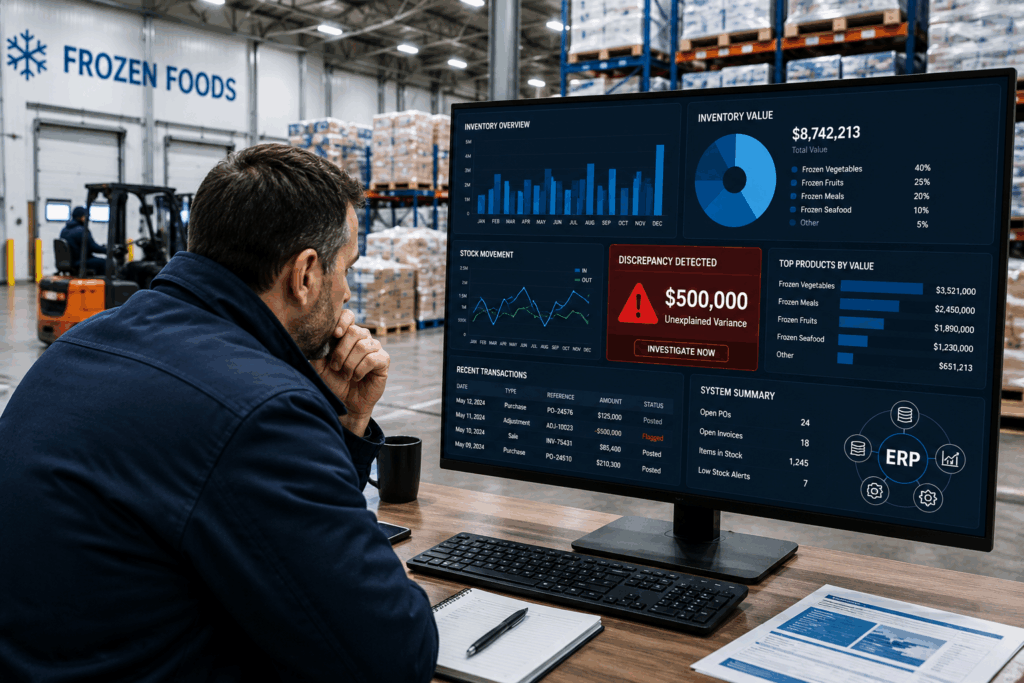
The result was a persistent inventory variance estimated at between $500,000 and $600,000 annually.
The discrepancy eventually appeared during year-end physical inventory counts, but only as a reconciliation issue. The root cause remained buried in the spreadsheet itself.
By identifying the source of the variance and correcting it, Nature’s Touch eliminated an ongoing financial gap while reducing future compliance and reconciliation risk.
The engineering impact was equally significant. A reconciliation process that previously required approximately 48 hours of manual analysis can now be completed in as little as 10 minutes through automated validation and pipeline execution.
The Quote Worth Reading Carefully
The line that matters most from the engagement isn’t the inventory figure.
It’s Tentomas’s observation about organizational adoption:
“If you want the most out of AI, you have to get the organization behind it in a way that doesn’t scare them and shows value quickly.”
That’s a more important statement than it initially appears.
Many AI initiatives begin with ambitious transformation goals and struggle to gain traction. Nature’s Touch took the opposite path. The project started by solving a real operational problem, demonstrating immediate business value, and building trust through measurable outcomes.
The $500,000 variance wasn’t just a financial discovery. It became evidence that better data foundations create better business decisions.
What This Engagement Was Really a Test Of
Read as a story about one food supplier, this is an inventory-reconciliation success story.
Read structurally, it tested three separate questions.
First, can agentic AI uncover business-critical issues hidden inside legacy operational logic? The reconstruction of the 72-page spreadsheet and discovery of the conversion error answered that.
Second, can automation reduce the manual effort required to maintain and validate critical supply-chain processes? The reduction from 48 hours to 10 minutes answered that.
Third, can solving foundational data problems create a realistic path toward broader AI adoption? The discovery of a half-million-dollar inventory variance answered that too, because it demonstrated that data quality isn’t a prerequisite for AI success, it is AI success.
Three different questions. One data foundation. One consistent answer.
What Comes Next
For Nature’s Touch, the inventory variance was never the end goal.
The broader objective is creating a data environment where every employee can access information in a way that aligns with their role, whether in finance, operations, procurement, or supply-chain management.
The company is now exploring Maia as an intelligent monitoring layer, with specialized agents continuously evaluating risks such as weather disruptions, regional supply shortages, and country-of-origin issues before they impact operations.
That shift changes the operating model from reactive to proactive.
Instead of discovering problems after shipments are delayed, teams can adjust sourcing and planning decisions in real time.
As Nature’s Touch continues exploring AI-driven forecasting, demand planning, and operational automation, the competitive advantage will not come from AI alone. It will come from having trusted, governed, immediately accessible data beneath it.
The ultimate goal is straightforward: move more work from two days to ten minutes.
And for a business where volatility is built into the supply chain, that may be the most valuable inventory correction of all.