
Few organisations operate in a static environment. As we move toward the last years of the 20th century, the pace of change in Markets across the globe has accelerated with the result that products have shorter life-cycles. An innovation or a new product development can make other products obsolete overnight. It is said that the research and development of new products is both creative and destructive. As new products are launched others fall by the wayside. The major effect of this pace of development is that Successful businesses have to invest in technological change. If they do not, they risk their products being overtaken by the products of their competitors. Nowhere is this more the case than in the pharmaceutical industry. For organisations in this industry good marketing involves:
- Looking outwards in order to respond to changes in markets, business conditions and competition
- Looking inwards in order to develop both the organisation and its products to meet consumer needs which have been identified through the marketing process.
American home products corporation is a global, Innovation-driven company focusing upon discovering and developing cost-effective health care products. Each year, the company commits approximately $1 billion to investment in pharmaceutical research to make it one of the world leaders in research and development investment. This process helps to ensure that the company is well positioned for future growth in an industry which is constantly providing new life-improving products.
This case study focuses upon just one of the many products from the diverse businesses of American home products – ChapStick. From its early origins as a simple health care product, it has become, today, a highly sophisticated and successful product in an extremely competitive market.
When we think of products, we tend to think of brands representing those products. A brand identifies the products from an organisation through specific features such as a name, sign, term, symbol or other creative element. ChapStick has a distinct advantage as a brand. The advantage is that the name ChapStick has become increasingly associated with the product. Today people refer to the vacuum cleaner as the Hoover, clear sticky-tape as Sellotape and when referring to lip balm – they say ChapStick.
The brand
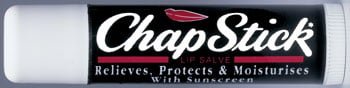
ChapStick has come a long way since a certain Mrs Morton melted the pink ChapStick mixture on her kitchen stove and poured the liquid through a small funnel into brass tubes. The rack was then moved to the porch for cooling, after which, the moulded ChapStick was cut into sticks and placed in containers for shipping. All of this was made possible in 1912 after Mrs Morton’s husband John had bought the rights to the product from a local chemist for $5.
Today the brand is owned by American Home Products Corporation and manufactured on a modern production line. During a typical shift, 85,000 units of the product are made.
Today’s product range
In the UK, Whitehall Laboratories (owned by American Home Products) makes a range of ChapStick which all contain a sunscreen. The product range is comprised of:
PRODUCT RETAIL PRICE
Original 1.05p
Strawberry 1.05p
Cherry 1.05p
Mint 1.05p
Orange 1.05p
Medicated £1.39
Medicated Gel £1.62
Sunblock 15 £2.45
The market
The market in which ChapStick sells is a growing one as it becomes normal practice for people to take more care of their lips. Sales continue to be highly seasonal as consumers see more of a need for the product in poor weather, i.e. when it is wet and cold in autumn and winter. However, this picture does not tell the whole story. Market research has shown that whilst:
- 47% of consumers use ChapStick for treating dry/sore lips,
- there are, in addition, 32% who use it to protect or moisturise their lips.
The target market for ChapStick is predominantly:
- Females aged 16 – 34 years.
There is also an increasing male market for ChapStick, especially amongst the young who are less conservative in their ways. 59% of young females claim to use ChapStick to “treat dry lips” by which they imply moisturising lips rather than treating sore ones. Whilst there are an increasing number of consumers who purchase ChapStick as a regular part of their lifestyle, i.e. to moisturise their lips, it seems that many buyers purchase a lip balm on impulse. This means that they see the product on display and say to themselves – “That’s a good idea, I could use that!”
This may be because they have dry or chapped lips at the time, or more likely because they feel that buying a lip moisturiser is going to make them feel good. The nature of the product and of purchasing patterns, mean that it is not particularly price sensitive. Consumers are just as likely to buy a Strawberry ChapStick at £1.03p or £1.07p as they are at £1.05p.
Market research in 1994 indicated that only 7% of consumers buy lip balm each month. The reality was that the majority of people bought lip balm only once a year or less often – this was the case for 79% of men and 56% of women. Therefore the product had not yet become a major part of the lifestyle of most people. However, amongst current consumers the product is widely used, i.e. 42% claim to use their lip balm at least once a week. Women consumers typically make frequent use of lip balm. In developing the market presence of a product, it is always helpful to examine what is happening in other markets where the product has been established for a longer period of time. For example, in the United States, several applications a day of lip balm are commonplace.
The competition
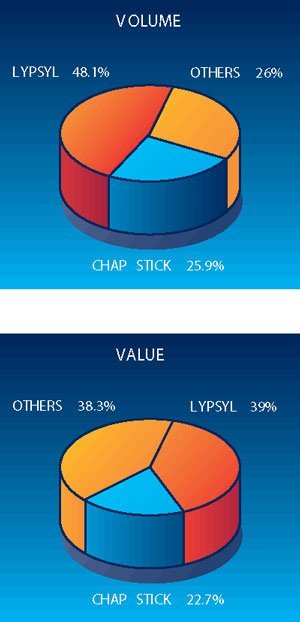
In the UK market ChapStick currently has the second highest market share. The current market leader is Lypsyl which has 48.1% of the market share through chemists, compared with ChapStick at 25.9%.
Lypsyl also has a strong presence through supermarkets and other retail outlets. Other competitors include Blisteze (sold largely for cold sores), Labello and own brands such as those at Boots and Superdrug, together with Body Shop products. The last twelve months has seen the emergence of two new competitors – Neutragena and E45. Competition has never been so fierce.
Continue learning
Finish this case study—and unlock 600+ more
You have read most of this study free. Choose full library access or buy this individual PDF.
Full case-study library
£29.00/month or £299.00/year
- Complete online access
- 600+ real-company case studies
- PDF where available
Individual PDF
£5.99 one-off
Secure checkout and access through My Account.
Buy this PDF
Apply the case
Learning activities
Identify
What business problem or opportunity is ChapStick addressing? Which stakeholders are most affected?
Analyse
Select two pieces of evidence about the marketing mix and explain why each one matters.
Evaluate
How effective was the organisation’s response? Reach a supported judgement and identify an alternative.