

Every marketing agency hits the same wall eventually. A handful of clients ask for Google Ads management in the same quarter, and suddenly the account manager who used to handle PPC “on the side” is drowning. Hiring feels like the obvious answer, but hiring takes months, and the cost of getting it wrong keeps climbing. The average cost-per-click across all industries reached $5.26 in 2025, and average cost per lead rose to $70.11. Amateur management is no longer a minor inefficiency; it’s an expensive one. So agency owners face a real decision in 2026: build a PPC department from scratch, or bring in a white label partner to run campaigns under the agency’s own brand.
The Real Cost of Building an In-House PPC Team
Hiring a competent PPC specialist sounds simple until you map out the actual timeline. Recruiting, onboarding, and getting a new hire to full competency on live client accounts typically takes 6 to 12 months, and that’s assuming the hire works out. Add Google Ads certification study time, a probationary period of mistakes on smaller accounts, and the inevitable learning curve on your agency’s own reporting tools, and you’re looking at the better part of a year before that person is pulling their weight. Meanwhile, PPC specialists are a competitive hire. Salary expectations have risen alongside the complexity of the platform itself, and turnover in performance marketing roles is notoriously high once a specialist builds a strong resume. This build-versus-buy tension mirrors the one many end clients face when weighing PPC management in-house versus outsourcing, except here it’s the agency itself deciding whether to grow its own team.
There’s also the opportunity cost. Every month spent training a junior hire is a month that account isn’t performing at the level a specialist could deliver. That gap shows up directly in client retention numbers, and clients don’t wait around for an agency’s internal team to catch up. This is where a growing number of agencies are choosing a different route. Rather than absorb the hiring risk themselves, they’re partnering with a specialist provider for white label google ads management, which lets the agency deliver expert-level campaign results under its own name from day one, without the 6-to-12-month runway a new hire requires.
What the 2026 Data Says About Outsourcing PPC
The numbers on outsourcing are hard to ignore at this point. Agencies that outsource 40-60% of service delivery grow roughly 2.3 times faster than peers, while maintaining profit margins 18-22% higher, according to Amra and Elma’s “Top 20 White Label Marketing Statistics 2025.” The same report found agencies using white label services report 42% higher client retention rates, and more than 60% of agencies now rely on outsourcing specifically to scale PPC campaigns. That’s not a fringe tactic anymore; it’s closer to standard practice among agencies that are actually growing.
Part of the reason is simple economics. As CPCs climb, and WordStream’s 2025 benchmark data puts average CTR at 6.66% and conversion rates between 7.52% and 8.18%, the margin for error in campaign management shrinks. The global white label services market itself is projected to reach approximately $99.19 billion by the end of 2026, according to Amra and Elma, a sign that the outsourcing model has moved well past early-adopter territory.
If you’re evaluating how your agency stacks up against competitors chasing the same clients, running your positioning through a resource like the best competitor analysis tools is a practical way to see where your service gaps actually are before you commit budget to fixing them.
How White Label Google Ads Management Actually Works
The operational model is more straightforward than most agency owners expect. A white label partner runs the account audit, builds and structures the campaigns, handles ongoing optimization, and produces the reporting, all under the agency’s own branding. The end client never sees the partner’s name; they see their agency delivering strong results. The agency owns the relationship, the strategy conversations, and the invoice. The partner is essentially an extension of the team that operates behind the scenes.
This matters most when an agency is trying to grow its client base without diluting service quality. Our guide to building a client acquisition strategy around paid search makes the point that acquisition and delivery only work if the campaigns themselves perform. New clients aren’t won on manual reporting or clever onboarding decks; they’re won and kept because campaigns hit their targets month after month. Rising costs make that harder than it used to be. Search Engine Land’s analysis of 2025 Google Ads trends found that costs kept climbing even as conversion rates improved for accounts under skilled management, which is exactly the gap a specialist partner is built to close.
Vetting a White Label PPC Partner: What Agencies Should Check
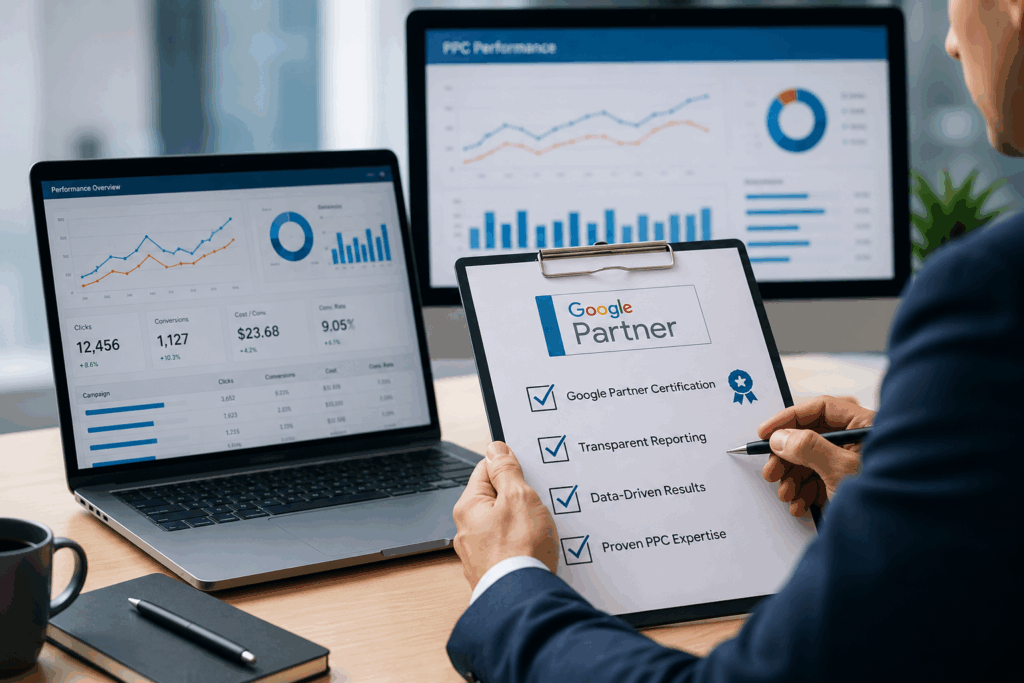
Not every white label provider operates at the same level, so vetting matters. Google’s own certification requirements are a reasonable starting point. To earn the Google Partner badge, a company needs at least one Google Ads-certified team member, a minimum of $10,000 in managed ad spend across accounts in a 90-day period, and performance requirements set by Google, according to Google Ads Help’s guidance on becoming a Google Partner. Premier Partner status, reserved for the top 3% of participating companies each year, is a stronger signal still.
Beyond certification, agencies should ask for transparent reporting standards, real case studies with named results, and clarity on margin structure before signing anything. Account ownership terms deserve particular attention: confirm in writing that the agency retains full control of client accounts, not the white label provider. A partner who resists that clause is worth walking away from, regardless of how strong their pitch sounds.
Weighing the Trade-Offs
White label PPC isn’t without drawbacks. There’s an extra communication layer between the agency and the people actually managing the campaigns, and direct day-to-day oversight is naturally reduced compared to sitting next to an in-house specialist. Some agency owners find that adjustment uncomfortable at first, especially on accounts where speed of response matters. The fix isn’t avoiding white label delivery altogether; it’s choosing a partner with clear escalation processes and response-time commitments built into the agreement. Strong partner selection resolves most of the friction that critics of the model point to.
This trade-off sits inside a bigger pattern, one that goes beyond PPC into the broader case for outsourced marketing functions generally. It’s about recognizing which capabilities are worth building internally and which are better handled by specialists who already have the infrastructure in place.
Conclusion
CPCs aren’t dropping, and client expectations for paid search performance aren’t easing up either. Agencies that pair careful partner vetting with white label PPC delivery are positioned to scale profitably in 2026 without risking months of runway on a hire who might not work out. The agencies still trying to build every capability in-house from scratch aren’t wrong to want control. They’re just taking the slower, riskier path to get there.