
Just ten years ago, career advancement often followed a single model. A person would earn a degree, get a job, and apply the same knowledge for years. Today, things are different. Business is changing rapidly, and with it, the demands on managers and specialists are growing.
That’s why distance learning has ceased to be just a convenient alternative. Now it’s a real tool that helps companies and individuals address the skills gap.
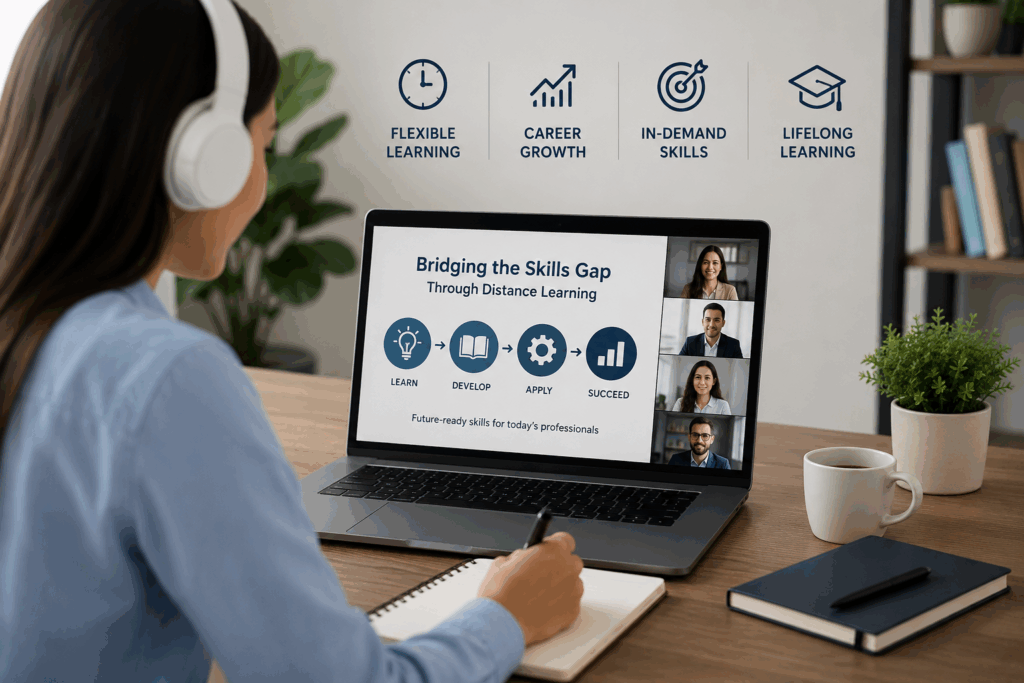
Why Businesses Face a Skills Gap
This issue isn’t an abstract problem. It manifests itself quite concretely. Companies may struggle to fill leadership openings, and employees can find it difficult to adapt to new tools and ways of working. This is especially acute in management, where competencies ranging from strategic thinking to data handling skills are critical.
The main challenge is speed. Rapid advances in technology, management methods, and customer expectations are outpacing traditional educational programmes. There is a disconnect between what specialists can do and what businesses need.
This gap is especially evident when switching roles or entering a new industry. The specialist may be very good at what they do now, but they don’t have the skills to move on to the next phase of their career. That’s where additional training for people can help without taking a long break from work.
How the Concept of Professional Development Has Changed
In the past, professional development was often equated with long-term face-to-face programmes. This took a lot of time and was often out of reach for those already working full-time. Modern, high-quality and flexible education from institutions such as the International Humanitarian College of London now allows people to develop the necessary skills without interrupting their careers.
This format is particularly suitable for mature professionals. They want more than a diploma and expect to practise what they learn right away. Modern programmes are thus increasingly concerned with real-world challenges rather than with abstract theory.
Another important change is the attitude towards the learning process itself. While education was previously perceived as a separate stage of life to be “passed” and completed, more and more professionals now view development as an ongoing process.
This also shapes expectations for educational programmes. They should be flexible, practical, and not require a complete career break.
Institutions Setting a New Standard of Quality
The rising demand for flexible learning has created a new type of college and university. These are programmes designed from the ground up for working adults, not courses transferred to an online platform. Among the institutions taking this approach is IHCL, which offers accredited master’s programmes and professional short courses for adults.
At the college, there is an emphasis on structured weekly teaching and continued support for students at every stage. This approach helps them combine study and work without sacrificing the quality of education. It is a good example of how a modern educational institution can connect theory with real-world business challenges.
What Skills Are Covered in Distance Learning Programmes
Demand varies across different skills. However, several areas are particularly important for managers and business professionals today. Modern distance learning programmes often focus on these priorities. The key competencies developed by such courses include:
- working with data and analytics;
- strategic planning and decision-making;
- team and project management;
- adaptability to digital tools;
- communication in a cross-cultural environment;
- leadership under uncertainty.
These are not limited to senior executives. They’re equally important for mid-level managers and professionals preparing for their next career move. This is why the demand for such programmes continues to grow.
Why Online Programmes Can Work Better Than Classic Courses
The real difference lies in the way the learning is structured. Well-designed programmes prioritise practice, frequent feedback, and short, focused learning units.
This is not the typical model of students sitting through long lectures and taking a single final exam. Modern programmes, on the other hand, involve constant interaction with instructors and opportunities for the immediate application of knowledge. Significant features of a truly effective learning programme include:
- regular feedback from instructors;
- practical assignments using real-world examples;
- flexible schedule to accommodate work commitments;
- clear structure for each learning module;
- student support at all stages;
- measurable progress after each block.
These principles make studying convenient and truly effective. Specialists see progress during the learning process, not just after receiving their diploma.
The Role of Technology in Distance Learning
The technological aspect of the issue deserves special mention. The quality of distance learning depends heavily on how user-friendly the platform is. A poorly designed system can undermine even a strong programme. If students struggle with the materials or with tracking their progress, motivation may quickly wane.
That’s why some educational institutions are paying more attention to their own digital solutions rather than standard platforms. A personalised learning system enables a logical student journey, from goal setting to interim assessments. This is especially important for adults, who don’t have the time to navigate cumbersome interfaces or search through dozens of tabs for the necessary materials.
What This Means for the Future of Professional Education
The trend is clear: people no longer see distance learning as a compromise. It’s becoming a practical solution to business needs. Companies need workers who can adapt and keep their knowledge current. These are exactly the capabilities that modern, flexible programmes develop.
Over time, the gap between traditional and distance education will narrow even further. Educational institutions will continue to experiment with formats to make learning as applicable as possible. And those professionals willing to embrace these changes will find new career opportunities more easily. When choosing the right programme, it is worth considering a few simple but important factors:
- transparent admission and learning requirements;
- real testimonials from programme graduates;
- balance of theory and practical assignments;
- recognition of the diploma in different countries;
- career development support after graduation.
These criteria help distinguish a truly high-quality programme from a formal set of lectures. For a mature professional, it’s important to see not only a diploma but also a clear path to success.
Conclusion
The skills shortage in business and management reflects a deeper shift in the labour market. Distance education helps close this gap by offering flexible, practice-orientated programmes. Consequently, professionals receive a unique opportunity to develop without breaks throughout their careers. In turn, businesses gain access to specialists who can adapt to new conditions faster than ever.