

It is easy to think about the present without considering the future. Consumers want more goods and services to improve their standard of living. The problem is they make choices about goods and services that have long-term consequences for the environment. In our modern world, organisations need to show responsibility. This means that they use resources efficiently, do not harm the environment and consider how what they do affects the ability of future generations to meet their needs.
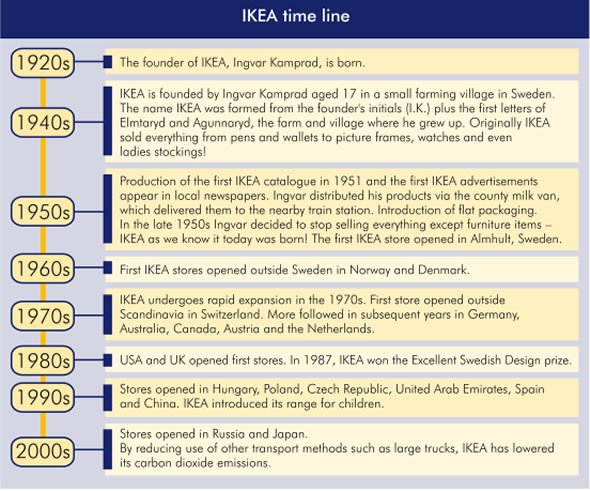
IKEA aims to be a responsible organisation. It sells low-price home furnishing products around the world. These include furniture and accessories for kitchens, bedrooms, living rooms, bathrooms and children”s rooms. IKEA now has stores in 36 countries around the world. It has come a long way in its 60 years of business.
IKEA vision
The direction for the organisation is provided by its vision. This acts as a guide for everybody within and outside the organisation about what IKEA wants to achieve.
IKEA’s vision is ‘To create a better everyday life for the many people.’
To meet its vision IKEA provides many well-designed, functional products for the home. It prices its products low so that as many people as possible can afford to buy them.
However, in creating low prices IKEA is not willing to sacrifice its principles. ‘Low price but not at any price’ is what IKEA says. This means it wants its business to be sustainable. IKEA supplies goods and services to individuals in a way that has an overall beneficial effect on people and the environment. Customers all over the world have responded positively to IKEA’s approach. This is evident in its increasing sales. In 2006 IKEA had a group turnover of nearly 18 billion euros.
Sectors of industry and sustainable supply chains
When consumers go to a retailer like IKEA, they will be looking at the different ranges of products and how they are presented. They may also look for quality customer service. However, consumers may not be aware that before products reach them, they must move from being raw materials through a variety of stages to becoming finished products suitable for sale. This is known as the supply chain.
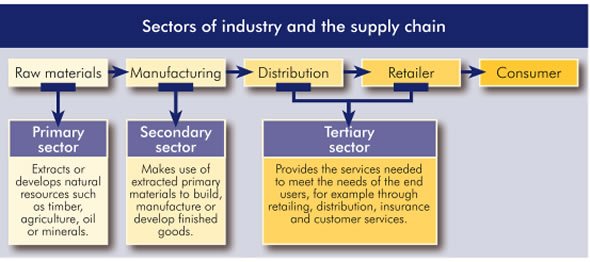
The supply chain involves a flow of production and processes through each of the three industrial sectors:

IKEA takes its responsibilities seriously and organises its operations in order to have a positive effect upon the environment:

- It aims that all the products and materials it takes from the primary sector do not harm the environment.
- Its products are manufactured in a responsible way.
The case study looks in detail how IKEA has achieved its aim to be a responsible business in each of the three sectors of the supply chain.
The primary sector

IKEA is not a primary sector organisation but it needs raw materials to develop its products. It therefore works closely with primary sector suppliers to ensure a sustainable impact on the people and the environment in which it operates. The primary sector involves the development of the raw materials. IKEA designs its own products. At the design stage, IKEA checks that products meet strict requirements for function, efficient distribution, quality and impact on the environment. Low price is one of the main factors that IKEA considers in producing well designed, functional home furnishings available to everyone.
IKEA buys products from more than 1,300 suppliers in 50 countries. It uses a number of trading service offices across the world. They negotiate prices with suppliers, check the quality of materials and analyse the environmental impacts that occur through the supply chain. They also keep an eye on social and working conditions at suppliers.
Environmental impact
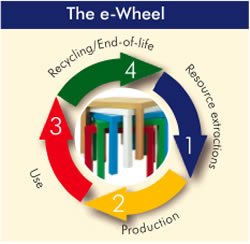
IKEA uses a tool – the ‘e-Wheel’ – to evaluate the environmental impact of its products. The e-Wheel helps IKEA to analyse the four stages within the life of a product. This also helps suppliers improve their understanding of the environmental impact of the products they are supplying.
Approximately 50% of IKEA’s 9,500 products are made from wood or wood fibres. This is a good resource as long as it comes from sustainable sources. It can be recycled and is a renewable resource.

IKEA creates many design solutions to minimise the use of materials. For example:
- some tables are made out of recycled plastic
- some rugs are made of material clippings that would otherwise be wasted
- products such as water cans are designed to be stacked. This means that more can be transported in each load, reducing the number of lorry journeys and therefore lowering fuel costs.
Each of these ideas helps IKEA’s products to be more sustainable and reduce the impact on the environment.
Supplier codes of conduct
A key part of IKEA’s success is due to its communications with materials’ suppliers and manufacturers. During manufacturing IKEA specifies to its producers that waste should be avoided. Where waste does occur IKEA encourages suppliers to try to use it in the manufacture of other products. IKEA has a code of conduct called the IKEA Way of Purchasing Home Furnishing Products (IWAY). This contains minimum rules and guidelines that help manufacturers to reduce the impact of their activities on the environment. The IWAY code complies with international legislation.
A product in use should not have a harmful effect upon consumers or their environment. For example, it should not cause allergies. If it uses energy, it should do so efficiently. When a product comes to the end of its useful life, it should be possible to reclaim or recycle the materials that make up the product. Such materials can then be re-used for making other products.
The secondary sector

Manufacturers within the secondary sector create IKEA products from raw materials. As products move through the supply chain, the process of value-added takes place.

IKEA designs many of its products so that the smallest amount of resources can make the best products. For example, IKEA saves on resources by using hollow legs in furniture (e.g. the OGLA dining chair). Another example is by using a honeycomb-paper filling material instead of solid wood for the inside of table tops (e.g. the LACK series).
As manufacturers or suppliers add value to products, the IWAY code of practice identifies IKEA’s minimum requirements.
The IWAY code of practice expects suppliers to:
- follow national and international laws
- not use child labour
- not use woods and glues from non-sustainable forests
- reduce their waste and emissions
- contribute to recycling
- follow health and safety requirements
- care for the environment
- take care of their employees
The application of the code raises standards. Each of the requirements within the code of conduct helps to develop sustainable business activities. They have a positive impact on the business environment in which the suppliers operate. They also improve the experience of people working for those businesses. To monitor suppliers, IKEA regularly carries out an IWAY audit. This involves talking to employees and inspecting documents and records. IKEA visits suppliers on-site on a number of occasions to ensure that they are following the code of conduct.
The code of conduct for suppliers and the work with other organisations underlines IKEA’s commitment to ‘low price but not at any price’. Although IKEA wants its customers to enjoy low prices, this should not happen at the expense of its business principles.
Sustainable partnerships
In 2000 IKEA formed a partnership with UNICEF to work on a community programme in Northern India. The aim of the work was to prevent child labour by raising awareness and addressing the root causes.
IKEA has also formed a partnership with the World Wildlife Fund (WWF). IKEA and WWF have committed themselves to promoting the sustainable use of natural resources. This helps to ensure that forests can be used both now and in the future.
To support sustainable partnerships with suppliers, IKEA works with other organisations.
For example, IKEA and WWF actions have led to:
- a series of training courses for people in Russia, Bulgaria, Romania and China on responsible forest management
- the development of forestry plans in China
- demonstrations to managers in Latvia on the benefits of responsible forestry
All these projects show IKEA’s commitment to supporting sustainable practices.
The tertiary sector

Businesses in the tertiary sector provide a service, such as banking, transportation or retailing. They do not extract the raw materials or make products themselves. 11% of businesses within the UK are retailers.
In the tertiary sector, IKEA’s retail stores add value to manufactured goods by providing a form of shopping different to the usual high-street experience. IKEA has more than 260 stores in over 36 countries. These meet the needs of consumers in a number of different ways:
Retailing turnover in the UK was more than £250 billion in 2006.
- Each IKEA store is large and holds more than 9,500 products giving lots of choice.
- Within each store, there are a number of realistic room settings that enable customers to see what the products would look like in their own homes.
- The IKEA store is built on a concept of ‘you do half, we do half; together we save money’. This refers to, for example, the customer assembling furniture at home.
- Customers handpick products themselves using trolleys.
- IKEA provides catalogues and home delivery to save customers” time.
- IKEA stores have restaurants that provide Swedish dishes alongside local food choices.
To make its activities more sustainable, IKEA has set up many local UK initiatives:

- In 2006 IKEA UK recycled more than 70% of its waste products. Its goal is to recycle 90% of materials.
- To reduce environmental impact, in 2006 IKEA UK started to charge for carrier bags. This reduced the use of carrier bags by 95%. In June 2007 IKEA UK removed carrier bags from its stores completely.
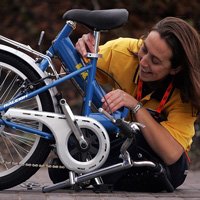
- In December 2006 IKEA UK gave a brand-new folding bike to each of its 9,000 employees. It also gave subsidised travel tickets to encourage them to travel to and from work on public transport.
- IKEA UK has provided low-energy light bulbs to its entire UK workforce and switched its fleet of company cars to low-emission hybrid models.
Conclusion
IKEA’s long-term ambition is to become the leading home furnishing company. However, for IKEA, getting there is not simply about developing profitability and market share.
As a global organisation IKEA has chosen to undertake a leadership role in creating a sustainable way of working. It has educated suppliers to understand how and why sustainable production is vital. This has helped IKEA differentiate itself from its competitors.
Consumers are made aware of IKEA’s commitment to sustainability through its involvement with many other organisations such as the WWF and UNICEF. IKEA is now considered by both suppliers and consumers to be a responsible company that they can trust.