


The reputation of a business may be affected by what its customers think and say about its products or services. This is driven by the experience of customers when dealing with the business. High-quality customer service will encourage customers to become regular or repeat users or purchasers. On the other hand, a poor customer experience may damage a business through loss of consumer confidence.
TNT was founded in Australia in 1946 by Ken Thomas with a single truck. Today, TNT is a global business and the market leader in business-to-business (B2B) express delivery services, delivering up to 150 million items per year. It has the largest individual share of the national market and employs over 10,000 people across the UK and Ireland. TNT operates in the tertiary (or service) sector of the economy which provides widely varying services to other businesses and to consumers. The tertiary sector is the largest sector of the UK economy, ahead of the primary (extraction) and secondary (manufacturing) sectors.

The Customer Promise
In 2008 TNT recognised that the increasing expectations of customers meant the business had to make major changes to ensure it could meet their needs. In-depth research showed that customer satisfaction depended not just on the process of delivering the service, but also on how the service was carried out. This resulted in TNT adopting a core strategy focused on delivering a quality customer experience. It developed a two-year programme to implement and communicate its Customer Promise to employees and customers.
In order to achieve the levels of process innovation and continuous improvement that the customer focus strategy required, TNT also needed to ensure the capabilities of its people were aligned to this, particularly in delivering a high quality customer experience. A review of new employees to the company showed that only 10% held qualifications above QCF (Qualifications and Credit Framework) level 2, compared to the industry norm of 52% (as identified by Skills for Logistics Research).
This case study examines how TNT’s Customer Promise reflects its core strategy of customer focus and aligns with its corporate values to influence the organisation’s culture.
Why is customer focus so important?

Customer service is a series of activities designed to deliver customer satisfaction. The process of providing customer satisfaction is based on an understanding of what customers want and need.
Effective businesses aim to anticipate and meet or exceed these needs. It also requires effective communication. A high-quality customer experience needs to apply from initial contact through to after-sales care, whether the customer generates a one-off transaction or regular repeat business.
Factors affecting customer satisfaction
There are many different aspects that underpin customer satisfaction in a business. These include:
- ease of use – educating customers so that they know how to get the best from the service or product and designing services that are easy to use and access
- personal relationships – building a rapport with customers to make them feel valued and that their needs are important, so that they develop an attachment to the service
- appropriate payment systems – enabling customers to pay in ways that are convenient to them and at appropriate times, such as on satisfactory completion of service
- an effective complaints process – dealing with any problems or complaints promptly and making sure customers know of the outcome
- after-sales service – checking that customers have had a satisfactory experience and offering other potentially relevant services to extend the customer relationship.

The various elements of providing a satisfactory customer experience should relate to customer needs. Relevant factors for TNT customers involve:
- on-time delivery – TNT aims to deliver all documents, parcels and freight to the customer’s required timescale through its door-to-door integrated air and road network
- 24/7 tracking – TNT’s sophisticated online technology makes it possible for customers to track where their consignments are at any time of day, giving them reassurance
- personal attention – TNT can accommodate specific customer requirements for safe delivery of unusual or fragile items. For example, on one occasion, the company transported a life-sized fibreglass Friesian cow from Scotland to a farm in Northern Ireland!
The customer experience at TNT

TNT’s market is highly competitive. In TNT’s market, there are at least 13 direct competitors. TNT’s Customer Promise is designed to deliver a competitive advantage, something that competitors will find hard to copy. As well as providing a ‘superior customer experience’, the Promise:
- supports TNT’s market-leading position
- helps to retain existing customers and attract new ones
- motivates staff by demonstrating their valuable input
- provides a means of differentiating the business.
In order to achieve differentiation, TNT has embedded the company’s values – ‘to be a trustworthy, values-based company with a reputation for integrity, transparency and compliance’ – into its Customer Promise. TNT claims: ‘Actions speak louder than words and that when we say “Sure we can”, we mean it’. This ‘can-do attitude and positive mindset affect all aspects of TNT’s business.
Demonstrating the Promise

The Customer Promise highlights the expertise and positive mindset behind TNT’s strapline ‘Sure we can’. It shows that TNT listens to customers and can add value. For example, TNT promises a ‘friendly voice at the end of the phone. To ensure this, TNT’s own knowledgeable people deal directly with customers. Its promise ‘to resolve problems promptly’ is demonstrated by how it intercepts and repackages damaged parcels to avoid goods being damaged and customers being disappointed.
Employees are instructed to be honest with customers – even if there is a problem. This fulfils its promise ‘not to over-promise. TNT aims for its drivers ‘to do you proud’ by training them so there is the same focus on quality customer service throughout the whole process. Its promise ‘to look after you’ is demonstrated in a variety of ways: by offering a range of delivery options such as door-to-door delivery as well as online booking which allows customers themselves to reschedule deliveries were necessary to make things easier. Its promise ‘to keep our promise’ is upheld by the fact that the standards are set at the top by the managing director and communicated throughout TNT so everyone is working to the same values.
Other examples of practical changes to improve the customer experience include an online ordering service for custom stationery and an online invoicing option for those customers who want it. TNT monitors and reviews regularly all activities relating to the customer experience, both internally and externally, to ensure it remains fresh for both customers and employees.
Continue learning
Finish this case study—and unlock 600+ more
You have read most of this study free. Choose full library access or buy this individual PDF.
Full case-study library
£29.00/month or £299.00/year
- Complete online access
- 600+ real-company case studies
- PDF where available
- Audio where available
- Crossword where available
Individual PDF
£5.99 one-off
Secure checkout and access through My Account.
Buy this PDF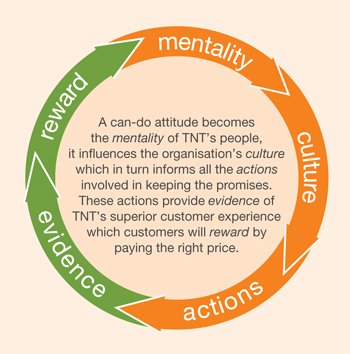


Apply the case
Learning activities
Identify
What business problem or opportunity is TNT addressing? Which stakeholders are most affected?
Analyse
Select two pieces of evidence about customer service and explain why each one matters.
Evaluate
How effective was the organisation’s response? Reach a supported judgement and identify an alternative.